01 / THE PROBLEM
The engineering challenge.
Waterjet and fabrication workflows need trustworthy placement across multiple sheets, remnants, irregular stock, cavities, repeated motifs, and operator review.
02 / CONSTRAINTS
What the solution must consider.
- Placement must support arbitrary contours, preserve requested quantities and maintain stock boundaries and part clearance. Desktop multi-sheet and remnant workflows have a broader scope than the browser strip-nesting demonstration.
03 / ENGINEERING APPROACH
Reasoning before geometry.
01Engineering method
Improve core placement, scoring, validation, and transformation contracts, using real jobs as regression inputs rather than hard-coded routes.
02Workflow features
DXF import and contour handling; Finite multi-sheet and irregular/remnant stock; Integrated cavity candidates; Motif and repeated-part strategies; Validation and operator diagnostics; Portable desktop packaging.
04 / DESIGN & IMPLEMENTATION
Connecting intent to execution.
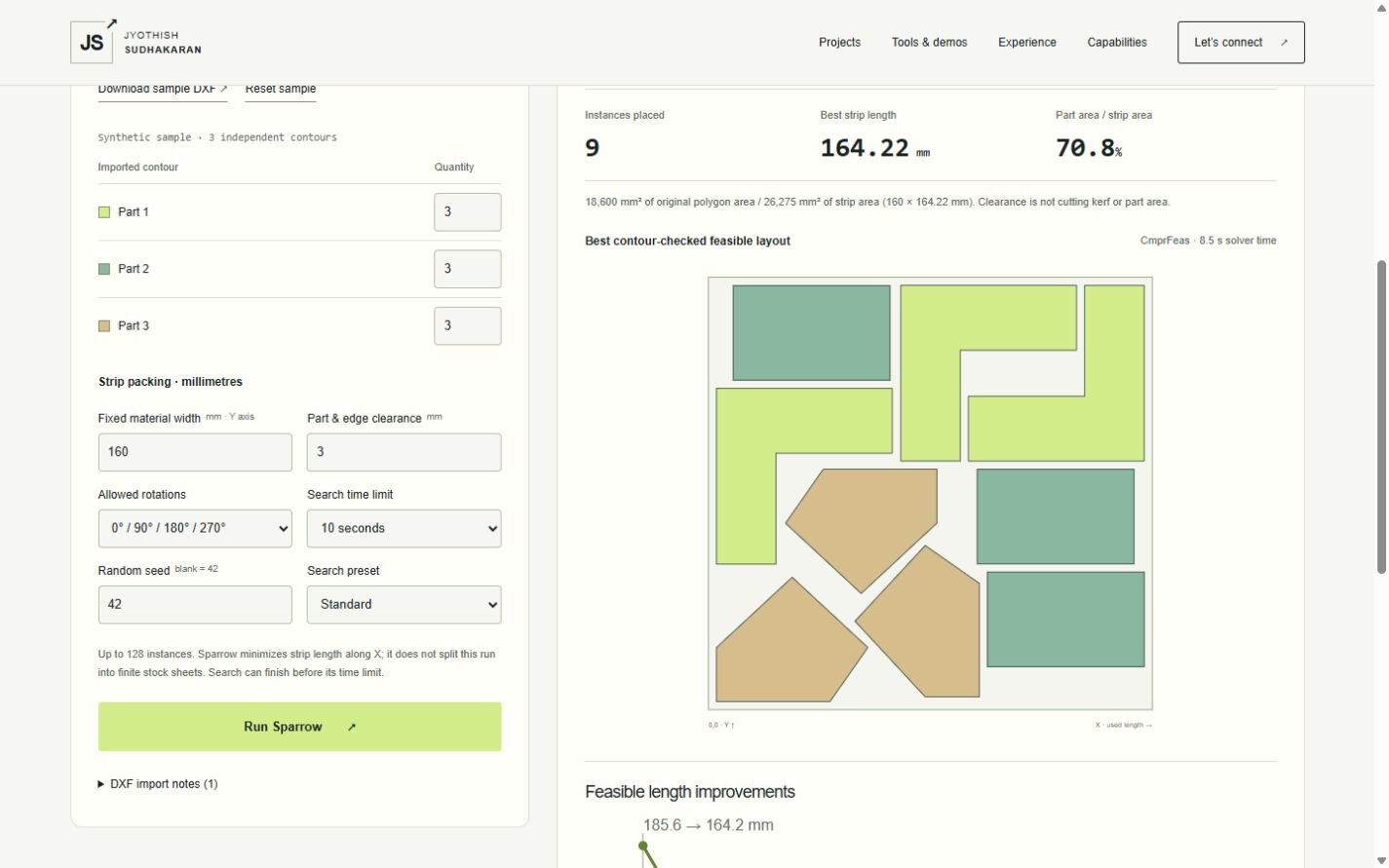
The desktop application evolved through v0.63.x, combining contour processing, placement strategies, stock handling and operator diagnostics. The browser workbench uses fixed-width strip nesting with editable part quantities and clearance.
- DXF import and contour handling
- Finite multi-sheet and irregular/remnant stock
- Integrated cavity candidates
- Motif and repeated-part strategies
- Validation and operator diagnostics
- Portable desktop packaging
05 / VALIDATION
The checks behind the design.
Engineering workflowBrowser engine tests and contour geometry checks cover quantity conservation, allowed rotations, clearance and strip boundaries. Sparrow and Jagua provide the upstream solver; my work connects the solver to the engineering workflow.
06 / OUTCOME
The value of the work.
Connects DXF geometry, operator requirements, upstream optimization and independent contour checks in an engineering-software workflow.
THE ENGINEERING PRINCIPLE
A compact layout must also be a feasible layout.
Material utilization measures occupied part area divided by stock area. It does not prove that contours stay inside the sheet or maintain the required separation. Geometry checks and solver quality are separate responsibilities.
A question for a technical conversation
How would you validate contour separation, stock boundaries and quantity conservation before releasing a nest?